
A hatchling no bigger than a few grams is drawing attention on Cape Cod for having two heads—and for showing just how unusual early development can be. Found in September 2026 at a protected nesting site, the two-headed turtle is now receiving care while wildlife professionals work to understand how its body is organized and what kind of future it might have.
A rare find on Cape Cod
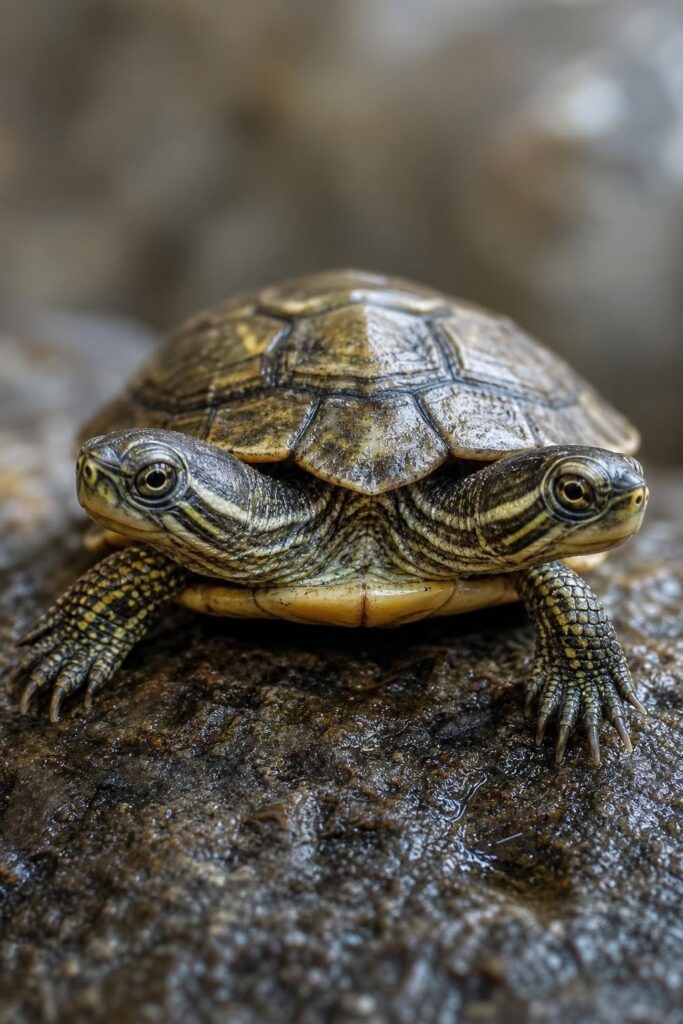
The hatchling is a diamondback terrapin, a turtle that lives in coastal salt marshes. It was discovered at Mass Audubon’s Wellfleet Bay Wildlife Sanctuary on Cape Cod, Massachusetts, and taken to the Birdsey Cape Wildlife Center in Barnstable, part of New England Wildlife Centers.
The tiny animal weighs about 5 grams. Staff report that it is active and eating, an encouraging sign for such a fragile hatchling. They have also observed that one of its heads bites, highlighting a challenge that can make everyday behavior more complicated for animals with duplicated body structures.
According to The Dodo’s reporting, this is only the third two-headed terrapin the center has treated. Its rarity is part of what makes the case scientifically valuable, especially because the turtle was found soon after hatching.
What bicephaly means
The condition is called bicephaly, meaning an animal has two heads. It results from incomplete splitting of an embryo, a process similar to what occurs with conjoined twinning. Instead of developing into two separate individuals, the embryo only partially divides.
The two heads do not necessarily mean that every other part of the body is duplicated. Depending on how development progresses, the animals may share some organs or have separate ones. In this terrapin’s case, that internal arrangement is not yet known.
Bicephaly is rare—local reporting places it at roughly one in 100,000 hatchlings. It is seen more often in reptiles than in mammals. Possible contributing factors include genetics and environmental stress, such as temperature. However, the presence of a two-headed hatchling does not by itself prove that one specific cause was responsible.
Why two heads can make survival difficult
In the wild, a two-headed turtle may face obstacles that ordinary hatchlings do not. Swimming can be difficult if the heads or sides of the body do not coordinate. Feeding may also become a contest, particularly when both heads respond to food or attempt to move in different directions.
The two heads can compete with each other, too. Even basic actions—turning, hiding, swimming away, or reaching food—may require coordination that the animal cannot easily achieve. A hatchling already faces danger from predators, and physical limitations can make escaping even harder.
For those reasons, two-headed animals often have short lives in the wild. Their survival is not impossible, though. Some have lived for years in human care, where food, shelter, and veterinary monitoring can reduce certain hazards.
What veterinarians hope to learn
Veterinarians plan to use X-rays and a CT scan to examine the terrapin’s internal anatomy. These images may show whether it has shared or separate organs and help the care team understand how its body functions.
The scans may also help determine the hatchling’s sex. That information can be difficult or impossible to establish from appearance alone at such a young age, and internal imaging may provide useful clues without relying only on external features.
For now, the turtle’s immediate condition is more important than predicting its entire lifespan. Being active and eating gives the care team a starting point, but its long-term prospects will depend on anatomy, coordination, growth, and how well both heads function together.
Why this terrapin matters
The discovery is notable beyond its unusual appearance. Diamondback terrapins depend on coastal salt-marsh habitat, and the species is listed as threatened in Massachusetts. That means every hatchling is part of a broader conservation story involving a species of concern in the state.
Because this turtle was found at a protected nesting site, it could be observed and transferred to professional care rather than left to face the risks of the wild immediately. Its treatment may also give wildlife specialists a rare opportunity to learn more about bicephaly in terrapins.
The case cannot answer every question about why developmental abnormalities occur. It can, however, provide information about how a two-headed turtle eats, moves, grows, and responds to care—details that are difficult to gather from such uncommon animals.
Takeaway
A two-headed turtle is the result of incomplete embryonic splitting, not a separate species. Bicephaly is rare and may involve shared organs, separate organs, or a combination of both. Although surviving in the wild can be difficult because of coordination, feeding, swimming, and predator-related challenges, some two-headed animals live for years under human care.
The Cape Cod terrapin remains under observation while X-rays and a CT scan reveal more about its unusual anatomy. For now, its activity and appetite offer a hopeful beginning, while its future remains uncertain.
Sources
– CBS Boston: Two-headed turtle found on Cape Cod
– Cape Cod Times: Two-headed terrapin found at Wellfleet Bay Wildlife Sanctuary
– Popular Science: Tiny two-headed turtle found on Cape Cod


