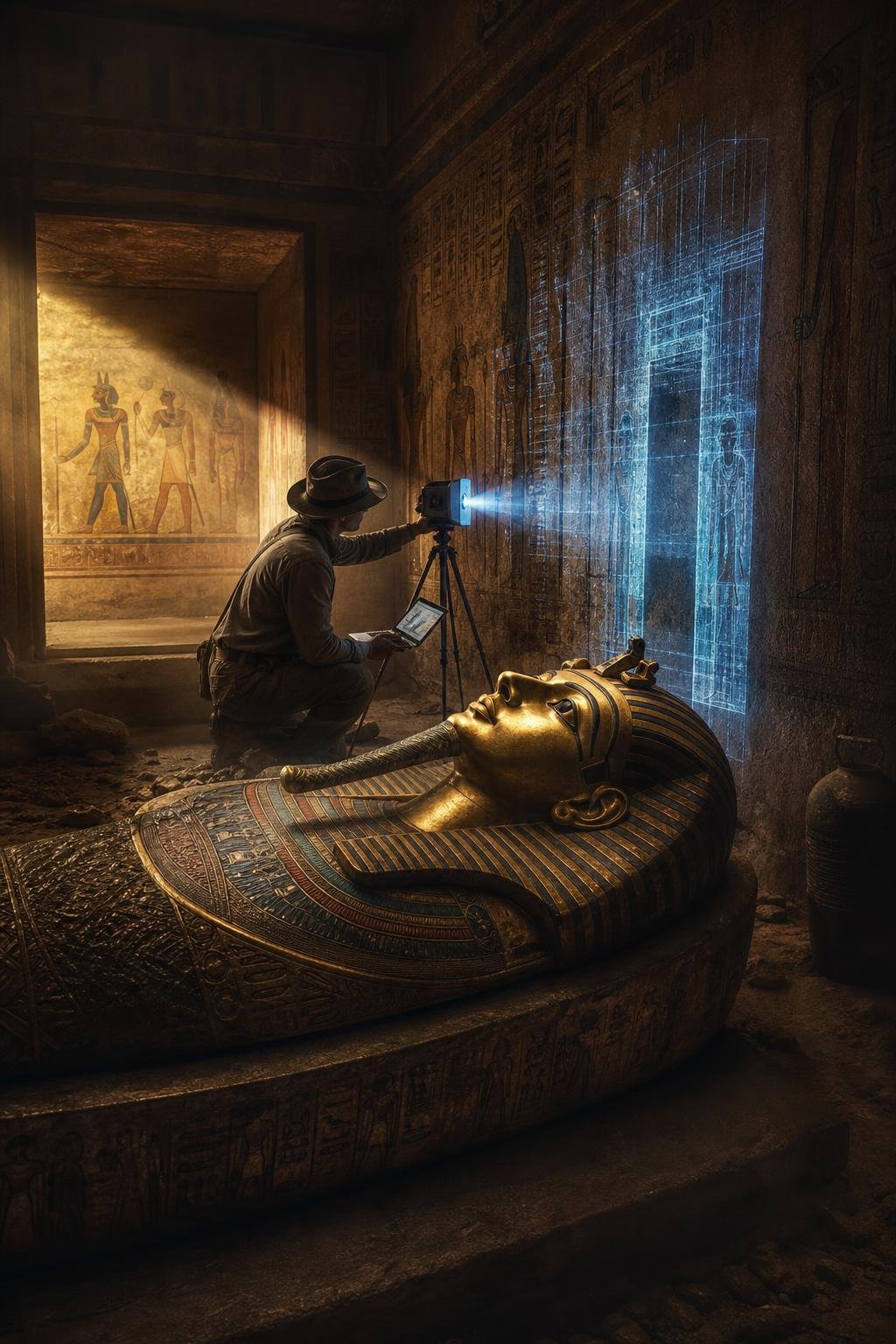
For nearly a century, King Tutankhamun’s tomb has seemed too small for a pharaoh—and new scans may explain why. Researchers have detected underground anomalies beyond the famous burial chamber in the Valley of the Kings, raising the possibility that Tutankhamun’s tomb, known as KV62, could connect to additional chambers. The most tantalizing theory is that those spaces might be associated with Nefertiti, the powerful queen whose tomb and remains have never been found. But the evidence remains suggestive, not conclusive.
What the New Surveys Found
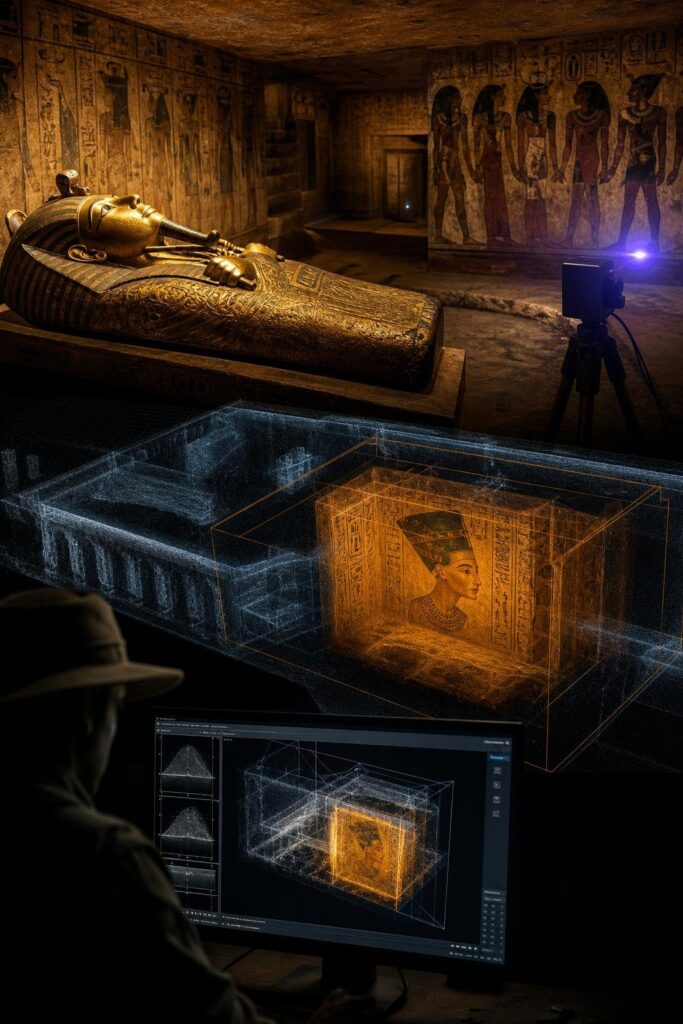
The latest investigation combined ground-penetrating radar with microgravimetry, a technique that can detect subtle variations in underground density. The results were published in September 2026 in the Occasional Papers of the Amarna Royal Tombs Project.
The research was led by Mamdouh Eldamaty, Egypt’s former antiquities minister. The team also included British Egyptologist Nicholas Reeves and British structural engineer George Ballard.
Their surveys identified several anomalies roughly 80 to 100 feet north of Tutankhamun’s burial chamber. The researchers argue that these features may represent additional chambers connected by passageways filled with rubble. They describe some of the possible structures as “highly speculative,” while assigning two of them reasonably high levels of confidence.
That distinction is important. The scans have not confirmed rooms, corridors, artifacts, or human remains. At this stage, the findings point to possible underground features that require direct investigation.
Eldamaty wrote that combining archaeological research with modern scientific methods can “reopen matters long thought settled.” If the interpretation is correct, he added, the discovery could rank among the most transformative archaeological discoveries of the modern era.
Why Nefertiti Is Part of the Mystery
The potential hidden chambers connect to a theory proposed by Reeves in 2015. He argued that KV62 may originally have been constructed for Queen Nefertiti, with its outer rooms later adapted for Tutankhamun after the young king died.
Reeves’s earlier work identified scan signals that he interpreted as traces of “two hitherto unrecognized doorways” beneath the painted surfaces of the tomb. Subsequent research produced conflicting evidence, however. Some investigations searched for a large void directly behind the wall and did not settle the question.
The new surveys do not prove that Nefertiti is beyond the tomb. They instead revive the possibility that the small, unusual layout of KV62 could reflect an earlier design.
Nefertiti was the wife of Akhenaten, who was likely Tutankhamun’s father, making her possibly the young king’s stepmother. Some historians believe she may also have briefly ruled as pharaoh. Her burial place and remains have never been identified, which has made her one of ancient Egypt’s most enduring mysteries.
The Tomb’s Unusual Design
Howard Carter discovered Tutankhamun’s tomb in 1922. Even then, he was puzzled by its modest size compared with other royal tombs in the Valley of the Kings.
The architectural argument behind the Nefertiti theory focuses partly on the direction of the tomb’s layout. Leaving Tutankhamun’s burial chamber requires a series of left turns, whereas other royal tombs from the period generally turn right from the burial chamber. The research team says the plan is that of an 18th Dynasty queen.
That interpretation remains debated. A small tomb could have resulted from Tutankhamun’s early death—he came to power around 1333 BCE at about age 9 and died roughly a decade later—or from changes made during construction. The layout may provide clues, but it cannot by itself establish who the tomb was originally built for.
Experts Urge Caution
Outside experts have described the findings as intriguing while emphasizing their limits. Ray Johnson, former director of the Epigraphic Survey, called the results “very tantalizing,” but noted that any chambers could have been damaged by flooding or a rising water table. Even if hidden spaces exist, they may not contain Nefertiti.
Christopher Gaffney of the University of Bradford said he felt “pretty ambivalent”: the data is fascinating, but not conclusive. Geophysicist Peter Styles of Keele University has also said he wants more information before drawing firm conclusions.
Their caution reflects the central problem with remote sensing. Radar and gravity-related measurements can reveal patterns consistent with cavities or altered ground, but interpreting those signals underground is difficult. Natural features, construction debris, moisture, and rubble can all complicate the picture.
For that reason, the findings should be described as scan anomalies—not confirmed hidden chambers.
What Happens Next?
The research team is seeking approval from Egyptian authorities to drill a small hole from above the suspected spaces and lower cameras into them. According to Nature, drilling could begin as early as November 2026 if permission is granted.
A camera inspection could provide much stronger evidence than scans alone. It might show whether the anomalies are genuine rooms, rubble-filled passageways, or something less dramatic. It could also reveal whether the spaces contain inscriptions, objects, or remains connected to Nefertiti.
Any intervention would need to account for the risks to the ancient monument. The possibility of flooding or a rising water table adds another concern, as does the need to avoid damaging the tomb’s structure and decoration.
Takeaway
New geophysical surveys have reopened the debate over hidden chambers beyond King Tut’s tomb. The anomalies may point to additional spaces, and the tomb’s unusual design keeps Nefertiti’s burial place in the conversation. Still, no hidden rooms—or remains of Nefertiti—have been confirmed. For now, the discovery is a compelling possibility awaiting physical evidence.
Sources
– Smithsonian Magazine
– Nature
– Archaeology Magazine


