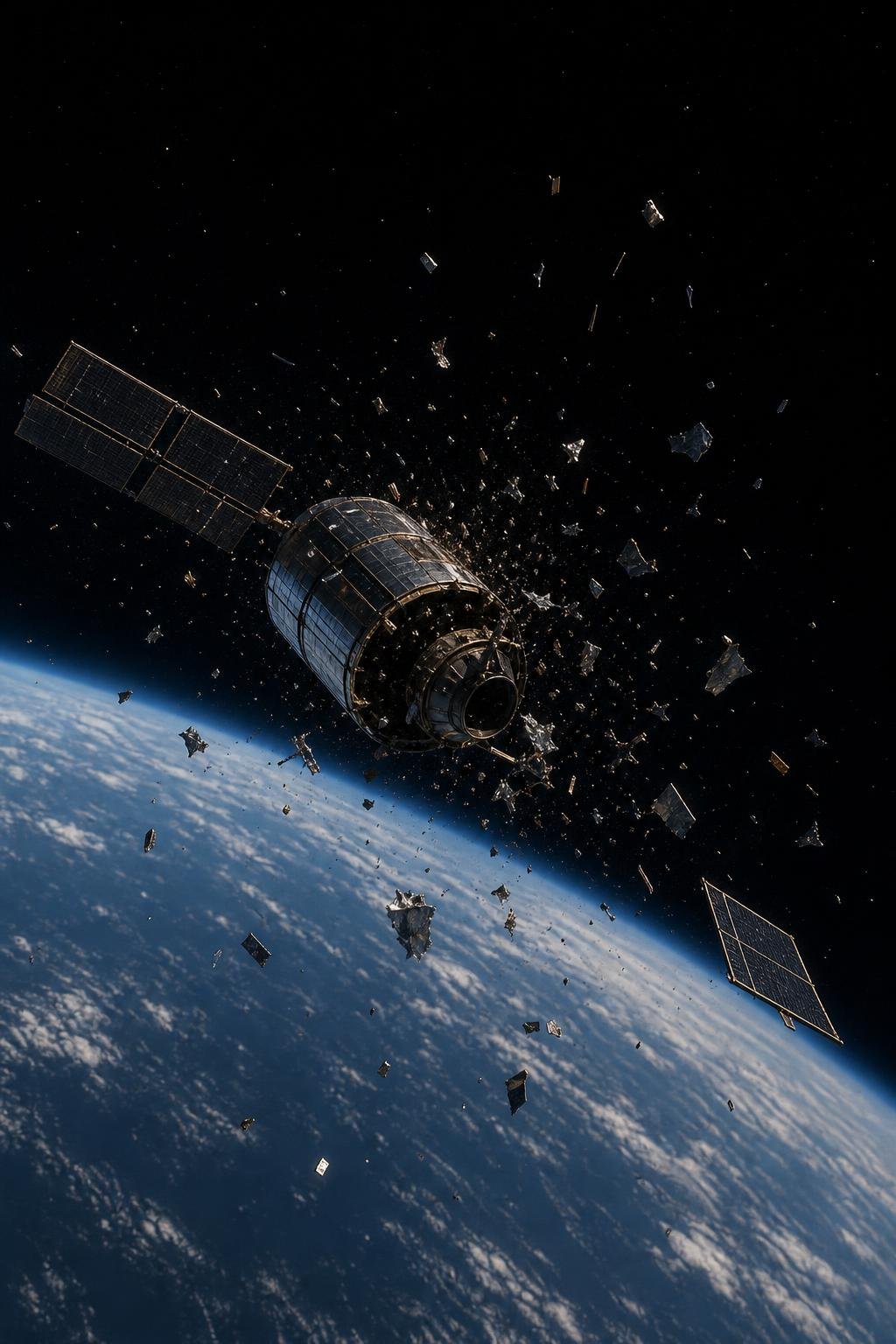
A Cold War relic has suddenly come apart nearly 480 miles above Earth, turning a once-secret American surveillance mission into a new cloud of orbital debris. The USA 32 spy satellite breakup was detected in September 2026, and officials still do not know exactly what caused the satellite to fragment—or how many pieces now circle the planet.
What happened to USA 32?
On Sept. 13, 2026, the defunct satellite known as USA 32 experienced a sudden “fragmentation” event. Space-Track, the satellite observation arm of the U.S. Space Force, announced the event four days later, on Sept. 17.
As of Sept. 28, officials had not publicly identified the cause or reported how many fragments were produced. The private tracking company s2a systems confirmed that the breakup occurred and photographed the largest remaining piece.
The event took place at an altitude of roughly 480 miles, or 775 kilometers, according to Spaceweather.com. A simulation from Spaceweather.com suggested that the debris spread into a ring around Earth in about 24 hours.
USA 32 is no longer operational and likely stopped working decades ago. Even so, its breakup adds more objects to an already crowded and hazardous region of space.
A once-secret Cold War mission
USA 32 was launched in 1988 by the National Reconnaissance Office, or NRO, aboard a Titan II rocket. Its mission was only fully declassified earlier in 2026.
The satellite was designed to intercept Soviet radar and radio signals from space. Its cylindrical shape led observers to describe it as a giant “tuna can,” a fittingly simple appearance for a spacecraft built during one of the most secretive periods of the Cold War.
The satellite was also known as Farrah III. The nickname followed a former NRO practice of naming satellites after well-known figures from the 1970s and 1980s. In this case, the name referred to actor Farrah Fawcett.
Although USA 32 was built for intelligence gathering, it had spent many years as an inactive object in orbit before breaking apart.
What might have caused the breakup?
The exact explanation remains uncertain. A collision with another tracked spacecraft appears unlikely because no other spacecraft has been reported as having struck USA 32, and major collisions are generally predicted in advance. However, an undetected space rock cannot be completely ruled out.
Old age may provide a more ordinary explanation. Spacecraft can retain batteries and leftover propellant long after their missions end. After 38 years of repeated heating and cooling in orbit, a pressurized tank or battery cell could have ruptured, according to Spaceweather.com.
That possibility has a precedent. The weather satellite NOAA-17 broke apart in 2021, and aging hardware was considered a possible factor.
Spaceweather.com also said it is too soon to fully eliminate the possibility of an anti-satellite weapon. But there is currently no evidence that a weapon caused this event. At this point, there may be nothing sinister about the USA 32 breakup.
Determining the cause could require identifying individual fragments and retracing their paths through space. That process may take months or even years. The breakup of Intelsat 33e in 2024, for example, is still being studied.
Why the debris matters
The altitude where USA 32 broke apart contains at least 200 other satellites. It is also already contaminated by debris from a 2009 collision between a U.S. satellite and a Russian satellite.
Every fragment adds another object that spacecraft operators may need to track. Even small pieces can create serious risks at orbital speeds, making the collision threat real in a region that is increasingly busy.
There have been no reported immediate problems. Russia launched a resupply mission to the International Space Station on Sept. 16, three days after the breakup. The station orbits at about 250 miles, or 400 kilometers—roughly half the altitude of USA 32’s breakup.
The International Space Station and China’s Tiangong space station are currently out of reach of the debris. However, fragments can gradually drift into lower orbits. If that happens, spacecraft operators could eventually need to perform avoidance maneuvers.
A reminder of the Kessler syndrome risk
The event also highlights a broader concern known as Kessler syndrome. This describes a possible chain reaction in which collisions create debris, the debris causes more collisions, and the growing cloud makes some orbital regions increasingly difficult—or eventually impossible—to use.
That outcome is not inevitable, and the breakup of one old satellite does not mean such a tipping point has arrived. Still, USA 32 shows why retired spacecraft remain relevant long after their missions end. A satellite that stopped serving its original purpose decades ago can still become a modern hazard without warning.
Takeaway
The USA 32 spy satellite breakup occurred on Sept. 13, 2026, at roughly 480 miles above Earth. The satellite was a declassified Cold War spacecraft built to intercept Soviet radar and radio signals. Its cause remains unknown, with aging hardware a plausible explanation and no current evidence pointing to a weapon. Tracking teams will need time to determine how much debris was created and whether any fragments could threaten other satellites.
Sources
– Live Science: An American Cold War-era spy satellite just exploded above Earth—and nobody knows why


