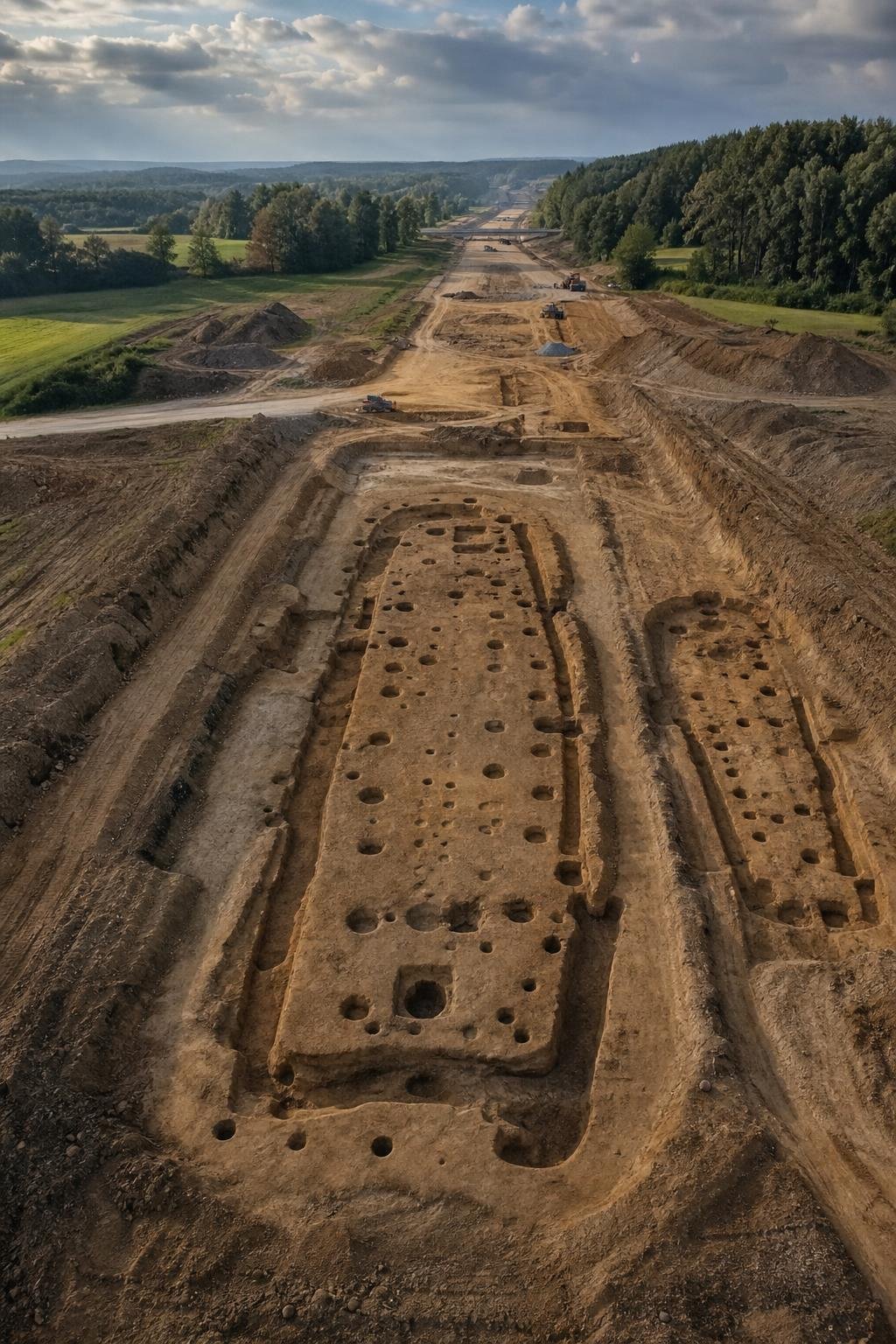
A stretch of future motorway in Czechia has opened an unexpected window onto thousands of years of human settlement. Before construction of the D55 motorway, archaeologists uncovered 1,879 settlement features, 65 Stone Age and Bronze Age graves, and a human burial within one of the settlements along less than 7 kilometers between Kokory and Přerov in the Olomouc Region of Moravia.
The rescue excavation, led by archaeologist Marek Kalábek of the Olomouc Archaeological Centre, reveals a landscape repeatedly used by communities from the Stone Age through later phases of the Bronze Age. Among the most significant discoveries are the remains of approximately 7,000-year-old Linear Pottery culture settlements and timber longhouses, some reaching about 36 meters—roughly 118 feet—in length.
All 12 expected sites confirmed
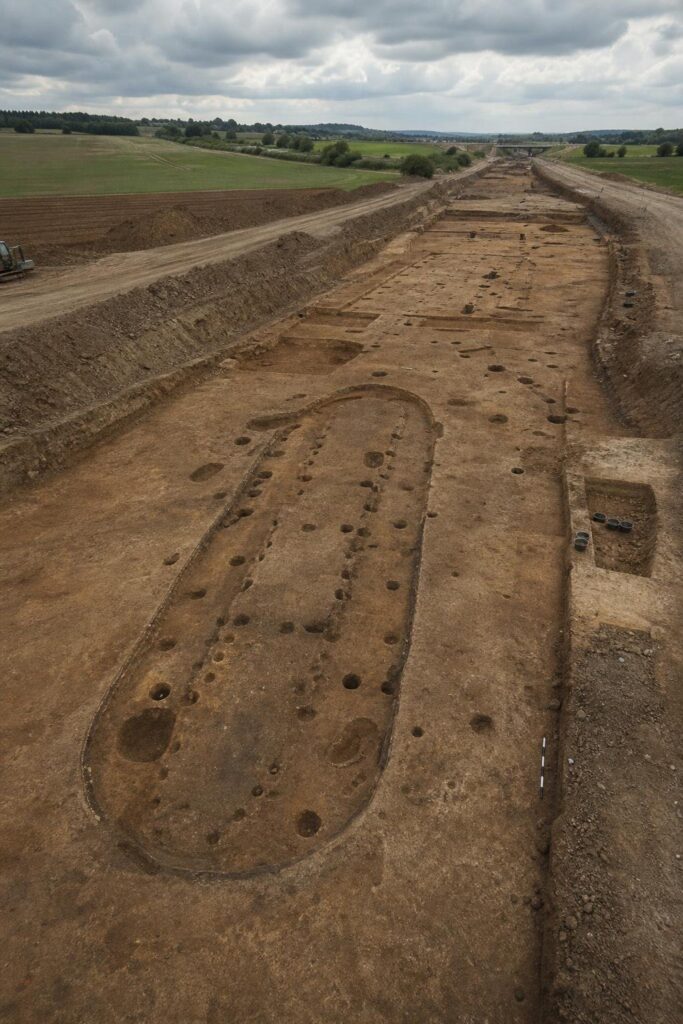
Archaeologists expected the motorway route to pass through 12 archaeological sites. Excavation confirmed every one of them, while also revealing a previously unknown site in the Dluhonice area.
Fieldwork began in September 2025 and continued until July 29, 2026. The work was necessary because the motorway construction could disturb or destroy buried archaeological remains. Such rescue excavations allow researchers to document the evidence before modern infrastructure changes the landscape.
The discoveries show that the area was not occupied during just one period. Instead, people returned to parts of this landscape again and again, leaving behind settlement remains, graves, tools, pottery and other traces of daily life.
Neolithic longhouses at Kokory–Podsedky
The largest concentration of remains was recorded at Kokory–Podsedky, where archaeologists documented 974 features. These included a settlement associated with the Linear Pottery culture, also known as Linearbandkeramik or LBK.
The LBK dates to approximately 5500–4900 BCE and is associated with some of the first farming communities in Central Europe. These early farmers are known for constructing large timber longhouses, which could serve as substantial homes and central structures within settlements.
At Kokory–Podsedky, archaeologists identified floors belonging to long timber houses, along with storage pits, ovens and other features connected with everyday activity. The size of some structures is especially striking: the longest houses extended up to 36 meters. Although only their preserved archaeological traces remain, these dimensions indicate the considerable scale of construction undertaken by Neolithic communities.
Storage pits and ovens provide a more practical view of life at the settlement. Together with the house floors, they suggest spaces where people prepared food, stored supplies and carried out ordinary household tasks. The remains do not simply mark where people lived; they record how the settlement functioned.
Bronze Age graves and a Dluhonice burial
The excavation also uncovered evidence from the Bronze Age. At Rokytnice–Za Oborou and Rokytnice–Podlesí, archaeologists found two Early Bronze Age burial sites and 18 burials dating to a later phase of the Bronze Age.
Another important find came from the Dluhonice area, where a burial contained ceramic vessels, a bronze object and a stone tool. These associated objects offer material evidence of the practices used when the individual was buried, although the wider meaning of the grave goods remains a matter for detailed archaeological analysis.
The finds from the burial areas add another layer to the story of the motorway corridor. The same general landscape that had earlier supported Neolithic settlements was also used for burial during later periods. This reinforces the picture of a place that remained meaningful or useful to different communities over a very long span of time.
What happens to the discoveries now?
Excavation is only the first stage of archaeological research. The recovered materials will undergo months of cleaning, conservation and documentation at the Olomouc Archaeological Centre. Researchers will then analyze the objects and remains in greater detail.
The material is expected to be transferred to the Museum of Archaeology of the Olomouc Region. Further study may clarify how the settlements were organized, how the longhouses were used, and how the burial practices changed between different periods.
Because the project covers multiple sites and time periods, the evidence can also help researchers compare communities that occupied the area thousands of years apart. The combined record—from LBK longhouses to Bronze Age graves—makes the excavation significant not because of a single spectacular object, but because of the unusually broad picture it preserves.
Takeaway
The Czech motorway archaeology project has documented a deeply layered landscape along the D55 route. Its 1,879 settlement features, 65 graves and additional settlement burial include some of the earliest farming evidence in the region, with Linear Pottery culture longhouses standing among the most remarkable discoveries. The findings show that people repeatedly lived, worked and buried their dead in this part of Moravia across thousands of years.
Sources
– HeritageDaily: Motorway Project Uncovers Vast Prehistoric Landscape


