Quick answer: Yes, Chinese ceramics really have been excavated at Great Zimbabwe, the medieval stone city in southern Africa. A study of the surviving collection identifies about 20 sherds of green-glazed Longquan celadon stoneware, one stoneware fragment from a kiln in Fujian province and three blue-and-white porcelain sherds from Jingdezhen, all dated between the early 14th and the late 15th century. They did not arrive with Chinese visitors. They came through the Indian Ocean trade network, passing through East African coastal ports such as Kilwa in exchange for goods that included the gold of the Zimbabwe plateau.
A handful of broken bowls and dishes may sound like a small find. At Great Zimbabwe they are among the clearest physical evidence that an inland African capital, hundreds of kilometres from the sea, was connected to a trading world that stretched as far as China. Here is what was found, how it is dated, and what it does and does not tell us.
What is Great Zimbabwe?
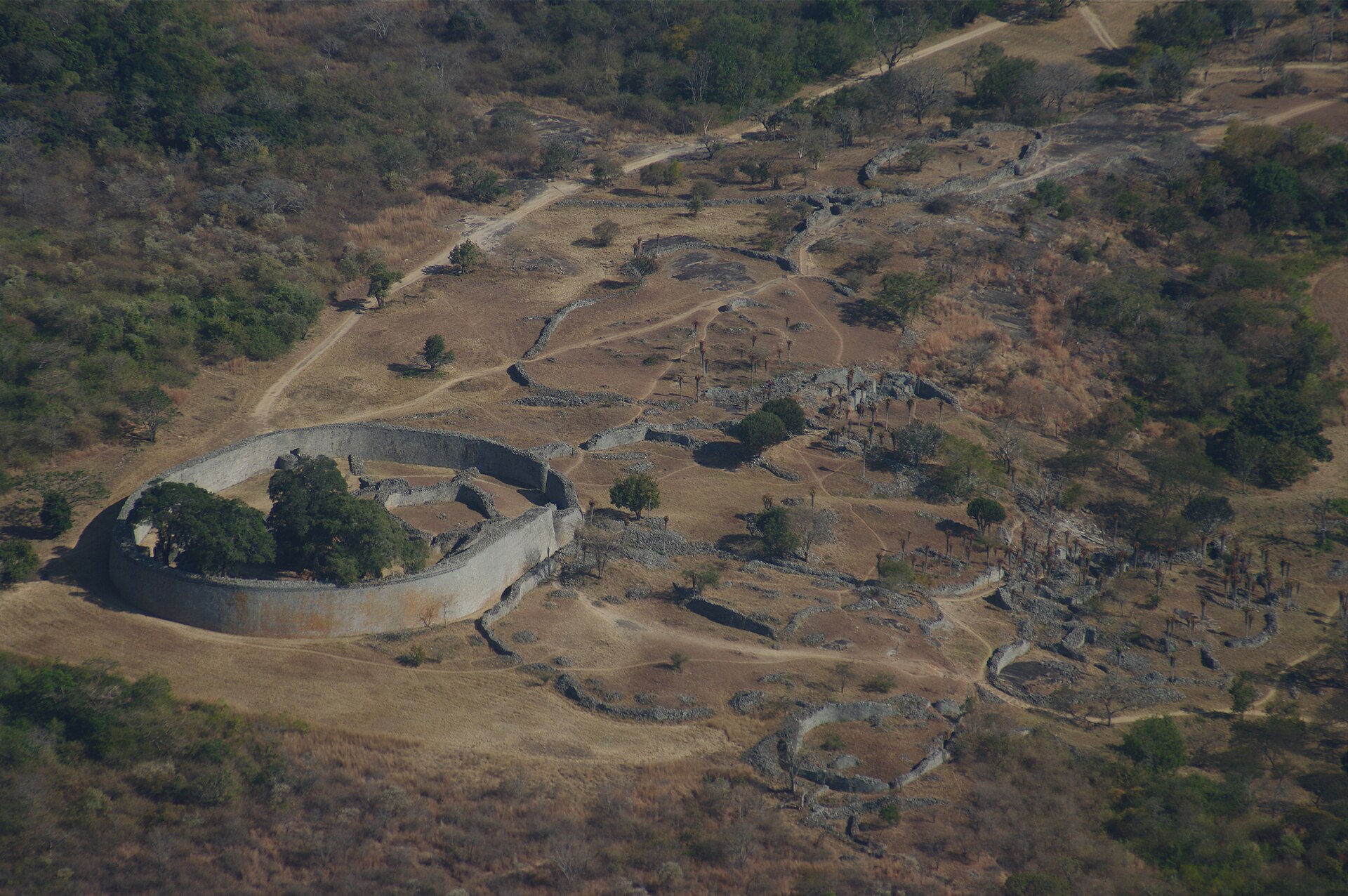
Great Zimbabwe is a complex of dry-stone ruins near the modern town of Masvingo in southeastern Zimbabwe. According to UNESCO, which inscribed it as a World Heritage Site in 1986, it was built between about 1100 and 1450 AD and is divided into three main areas: the Hill Ruins, the Great Enclosure and the Valley Ruins. The Great Enclosure, an elliptical wall of cut granite blocks enclosing a high conical tower, dates to the 14th century.
UNESCO describes the 14th-century city as the principal centre of a major state extending over the gold-rich plateaux, with a population of more than 10,000 people. It was founded by Iron Age Bantu-speaking ancestors of the Shona and was abandoned around 1450, when the surrounding land could no longer feed the city.
What Chinese pottery was found there?
The most detailed modern inventory comes from a 2015 study by the archaeologist Zhao Bing, published in the journal Afriques, which reviews Chinese ceramics found at sites across East and southern Africa. For Great Zimbabwe, the collection now kept in museums in Zimbabwe and South Africa includes:
- About 20 sherds of Longquan celadon: pieces of bowls and plates made of green-glazed stoneware from the Longquan kilns in Zhejiang province, one of the most widely traded Chinese ceramics of the period.
- One green-grey glazed stoneware bowl fragment attributed to the Zhuangbian kiln near Putian in Fujian province.
- Three blue-and-white porcelain sherds from Jingdezhen in Jiangxi province, the great porcelain centre of late imperial China.
Zhao dates the whole group to between the beginning of the 14th and the end of the 15th century, which falls within the Yuan (1271–1368) and early-to-mid Ming dynasties. Strictly speaking, then, most of the Chinese “porcelain” from Great Zimbabwe is celadon stoneware, and true porcelain makes up only a few pieces.
UNESCO’s site description confirms the wider picture: excavations at Great Zimbabwe revealed “glass beads and porcelain from China and Persia, and gold and Arab coins from Kilwa.” The 1986 ICOMOS evaluation written for the World Heritage nomination also notes that a 14th-century Arab coin minted at Kilwa was found at the site.
Why the collection is so small
The surviving assemblage is modest partly because of what happened to the site in the colonial era. Zhao notes that both Great Zimbabwe and the earlier site of Mapungubwe were heavily pillaged in the 19th and early 20th centuries, and many objects were removed before any systematic archaeology took place. What survives is a fraction of what was once there.
How did Chinese ceramics reach the interior of Africa?
Great Zimbabwe sits several hundred kilometres from the Indian Ocean. Its link to the outside world ran through the Swahili coast, a chain of trading towns on the East African shore. The most important of them in this period was Kilwa Kisiwani, an island port in present-day Tanzania that is itself a UNESCO World Heritage Site. According to UNESCO, between the 13th and 16th centuries much of the Indian Ocean trade passed through the hands of Kilwa’s merchants, who exchanged gold and ivory from the hinterland for silver, carnelians, perfumes, Persian faience and Chinese porcelain.
Ships from Arabia, Persia and India crossed the Indian Ocean on the monsoon winds, bringing cloth, glass beads and ceramics, including Chinese wares that had already travelled west through ports in Southeast Asia, India and the Persian Gulf. In return, the African coast supplied gold, ivory and other goods. Zhao identifies Great Zimbabwe and Mapungubwe as among the main sources of African gold between about 1200 and 1450.
The ceramics then moved inland. Zhao points out that no remains of mosques have been found at either Great Zimbabwe or Mapungubwe, and argues that exchange with the interior was probably handled by local merchants from the coast rather than by Swahili traders settling inland. In Zhao’s reading, Kilwa played a key role in distributing Chinese imports into the hinterland from the 13th to the early 16th century.
How are the sherds dated?
Chinese kilns produced distinctive shapes, glazes and decorations that changed over time, and specialists can often place a sherd within a few decades by comparing it with dated pieces from China and from shipwrecks. Imported objects found at Great Zimbabwe, including Chinese ceramics, Persian wares and glass, have long been used as an independent check on radiocarbon dates for the site, and they fit the 13th to 15th century peak of the city.
Those dates can also be revised as methods improve. A 2005 study in the Journal of Raman Spectroscopy re-examined celadon sherds from Mapungubwe, which had been classified in the 1930s as Southern Song (12th–13th century). Using Raman spectroscopy and other laboratory techniques, the researchers concluded that the pieces were more likely Yuan or early Ming. Results like this matter because the ceramics help anchor the timeline of the whole region.
What the Chinese pottery tells us, and what it doesn’t
It tells us that Great Zimbabwe’s rulers had access to luxury goods from across the Indian Ocean, and that the city’s wealth was tied to a trade system linking southern Africa with the Middle East, South Asia and China centuries before European ships arrived in the region in the late 1490s.
It does not tell us that Chinese people visited, settled in or built Great Zimbabwe. There is no archaeological evidence for that. The ceramics changed hands many times before reaching the plateau. During the colonial period, some writers pointed to imported objects like these to argue that the city must have been built by outsiders. Archaeologists rejected that idea in the early 20th century, and it has no scholarly support today. UNESCO describes the site as “unquestionably of Bantu origin.” The imports are evidence of trade, not of foreign builders.
Ceramics have a way of rewriting history once they leave the ground. For a Mediterranean example, see our report on a 2,100-year-old shipwreck off Turkey that was carrying luxury dinnerware to Rome. For more archaeology, read about a bronze ring showing the Lighthouse of Alexandria, the first intact graves found at Göbekli Tepe and an Etruscan princely tomb at Vulci, or browse our Science section.
Frequently asked questions
Was Chinese porcelain really found at Great Zimbabwe?
Yes. UNESCO lists porcelain from China among the finds from excavations at the site, and a 2015 study by Zhao Bing identifies about 20 Longquan celadon sherds, one Fujian stoneware fragment and three Jingdezhen blue-and-white porcelain sherds in the surviving collection.
How old are the Chinese ceramics from Great Zimbabwe?
They date from the early 14th to the late 15th century, the period when Great Zimbabwe was at its height and China was ruled by the Yuan and then the Ming dynasty.
How did Chinese pottery get to Great Zimbabwe?
Through the Indian Ocean trade. Chinese wares were shipped west through Asian and Middle Eastern ports to the Swahili coast of East Africa, where towns such as Kilwa traded them, along with cloth and glass beads, for gold and ivory. Merchants then carried them inland to the Zimbabwe plateau.
Does this mean Chinese explorers reached Great Zimbabwe?
No. There is no evidence that Chinese people ever travelled to Great Zimbabwe. The ceramics passed through many hands before arriving, and the city was built by the Bantu-speaking ancestors of the Shona people.
Where are the Great Zimbabwe ceramics kept today?
According to Zhao Bing’s study, the surviving Chinese ceramics from the site are held in museum collections in Zimbabwe and South Africa.
Sources: UNESCO World Heritage Centre, Great Zimbabwe National Monument; ICOMOS evaluation (1986); Zhao Bing, “Chinese-style ceramics in East Africa from the 9th to 16th century,” Afriques (2015); Prinsloo et al., “Re-examination of Mapungubwe Chinese celadon sherds,” Journal of Raman Spectroscopy (2005); UNESCO, Ruins of Kilwa Kisiwani.
Featured image: The Great Enclosure and Valley Ruins at Great Zimbabwe, seen from the Hill Ruins. Photo by Janice Bell, CC BY-SA 4.0, via Wikimedia Commons.


