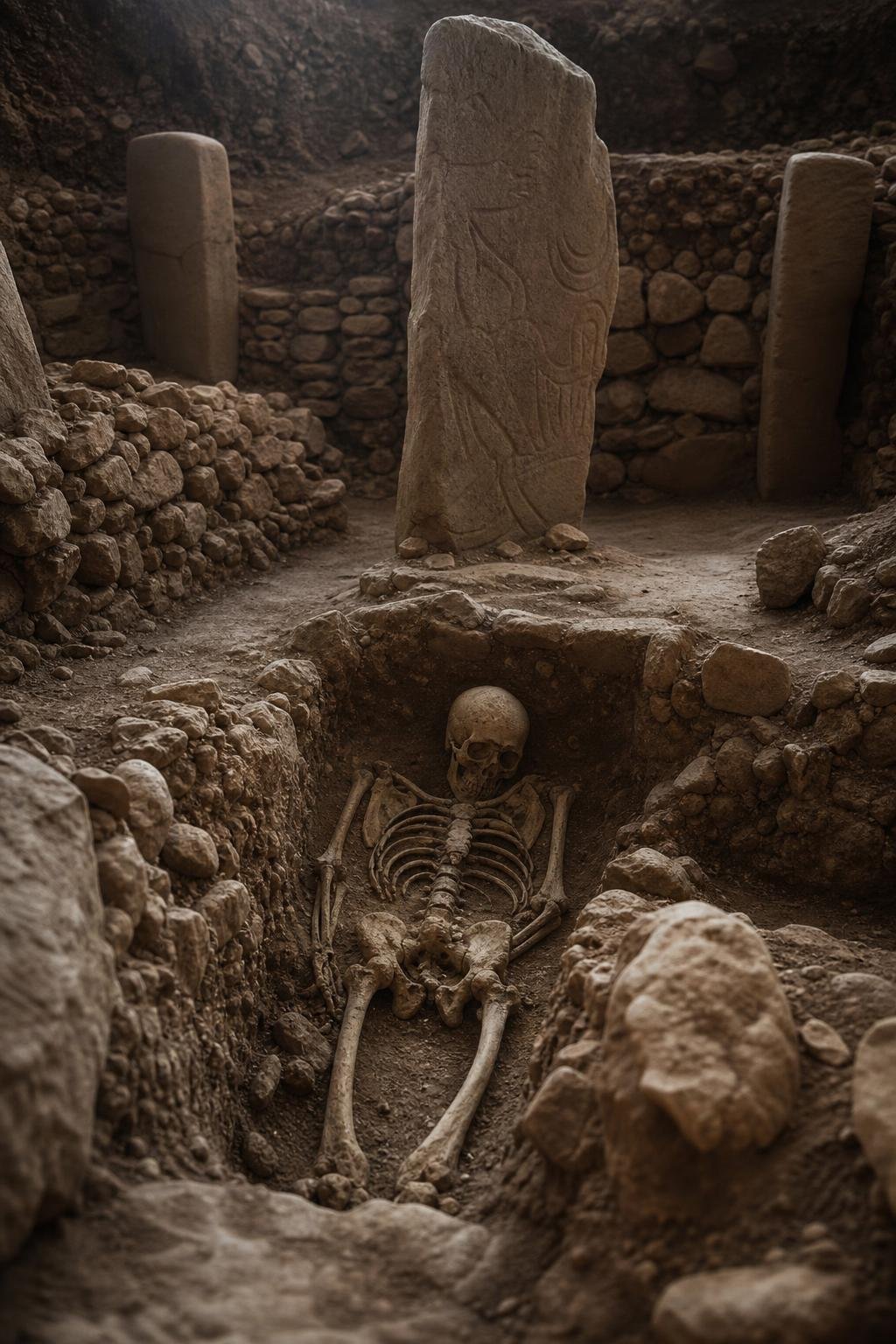
For decades, Göbekli Tepe was understood mainly as a place where hunter-gatherers gathered for rituals around towering stone monuments. Now, the discovery of the site’s first two intact human burials adds a more personal dimension: people did not merely visit this ancient complex. They also lived, worked, and buried their dead there.
The first intact Göbekli Tepe burials
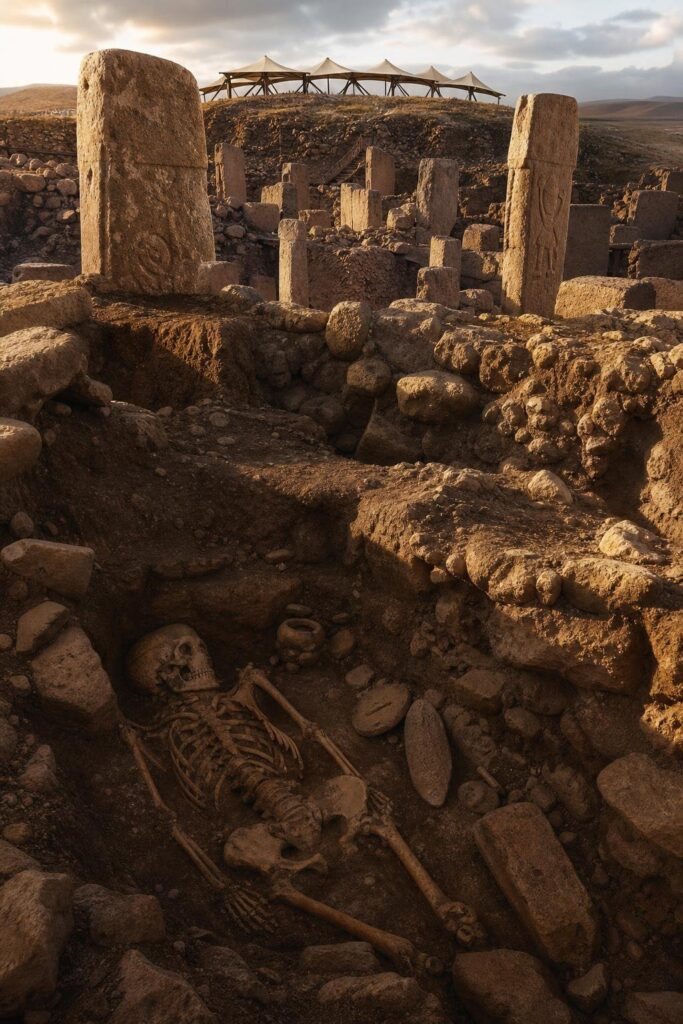
A study published in PLOS ONE in September 2026 reports the first two intact human burials ever identified at Göbekli Tepe. The research was led by Julia Gresky of the German Archaeological Institute and Lee Clare.
The burials date to approximately 8700–8000 BCE, during the Pre-Pottery Neolithic B period. One grave, discovered in 2017, contained three individuals in a collective burial. The second, found in 2022, held a single young woman.
These discoveries are significant because they provide direct evidence of burial activity within the site itself. Earlier excavations had uncovered human bones, but those remains were fragmented and found in unusual contexts. The newly reported graves offer a clearer connection between the people who used Göbekli Tepe and the place where they were laid to rest.
A monument complex with homes nearby
Göbekli Tepe is an approximately 11,500-year-old archaeological site in southeastern Türkiye. It is known for its monumental T-shaped stone pillars arranged in circular and rectangular enclosures. The site has long been described as the world’s oldest temple, and its builders are generally understood to have been hunter-gatherers.
The newly studied graves were located in areas associated with domestic or residential buildings next to the monumental structures. Their placement supports the view that Göbekli Tepe was not exclusively a destination for occasional ceremonies.
Instead, the evidence points to a more complicated settlement. People appear to have occupied the area, carried out everyday work, participated in activities around the monumental buildings, and buried members of their community nearby. This does not eliminate the site’s ritual importance, but it challenges the idea that its monumental areas stood apart from ordinary life.
The graves therefore help connect Göbekli Tepe’s famous architecture with the people who created and used it. The pillars remain central to understanding the site, but the burials show that the surrounding residential spaces may be just as important for reconstructing its history.
Rethinking the “skull cult” theory
Since excavations began in 1995, researchers have recovered more than 900 fragmented human bones from the fill of the monumental buildings. Their presence helped fuel theories that Göbekli Tepe was associated with a so-called “skull cult.”
Earlier research also reported some modified skull fragments. In 2017, researchers described skull pieces with carved grooves, a finding that contributed to speculation about special treatment of human remains.
The new study offers a different interpretation of most of the fragmented bones. Its authors suggest that many of them may have come from sub-floor burials in houses located upslope. Natural erosion or landslide processes could then have moved the remains downhill and into the monumental buildings.
Under this explanation, the bone fragments do not necessarily represent a practice focused on skulls or the deliberate placement of human remains inside the monuments. Some modified fragments remain part of the archaeological record, but the broader collection may have been redeposited rather than intentionally assembled as a ritual display.
That distinction matters. Archaeologists often have to reconstruct past behavior from remains that have been disturbed by later activity or natural forces. The intact graves provide a new point of comparison for interpreting the fragmented material.
What the graves reveal about ancient life
The Göbekli Tepe burials do not answer every question about the site. The exact relationship between domestic activities, burial customs, and the monumental enclosures remains a subject for further study. It is also uncertain how frequently people lived at the site or how all of its spaces were used over time.
Even so, the discoveries change the picture in an important way. Human remains are no longer represented only by scattered bones in the fill of monumental buildings. Researchers can now examine burials found in residential areas and consider how they fit into the wider settlement.
The collective grave containing three individuals suggests that more than one person could be buried together. The grave of the young woman demonstrates that individual burial also occurred. The available findings do not establish a single, uniform burial practice for everyone at Göbekli Tepe.
Most importantly, these Göbekli Tepe burials place death within the same landscape as domestic life and monumental construction. They suggest that the community’s relationship with the site was not limited to ceremonies performed at a special destination. Göbekli Tepe may have been a lived-in place where social, practical, and ritual activities overlapped.
Takeaway
The first intact graves at Göbekli Tepe offer the clearest evidence yet that people lived and buried their dead beside the site’s monumental structures. They also encourage a reassessment of the more than 900 fragmented human bones found in those buildings. Rather than proving a widespread “skull cult,” much of that material may have been carried into the monuments by erosion or landslides from burials in homes above them. The discoveries make Göbekli Tepe less like an isolated temple and more like a complex community landscape.
Sources
– PLOS ONE study
– Archaeology Magazine: Intact Burials Excavated at Göbekli Tepe
– Science: Bones Link 10,000-Year-Old Temple Complex to Village, Not Skull Cult


