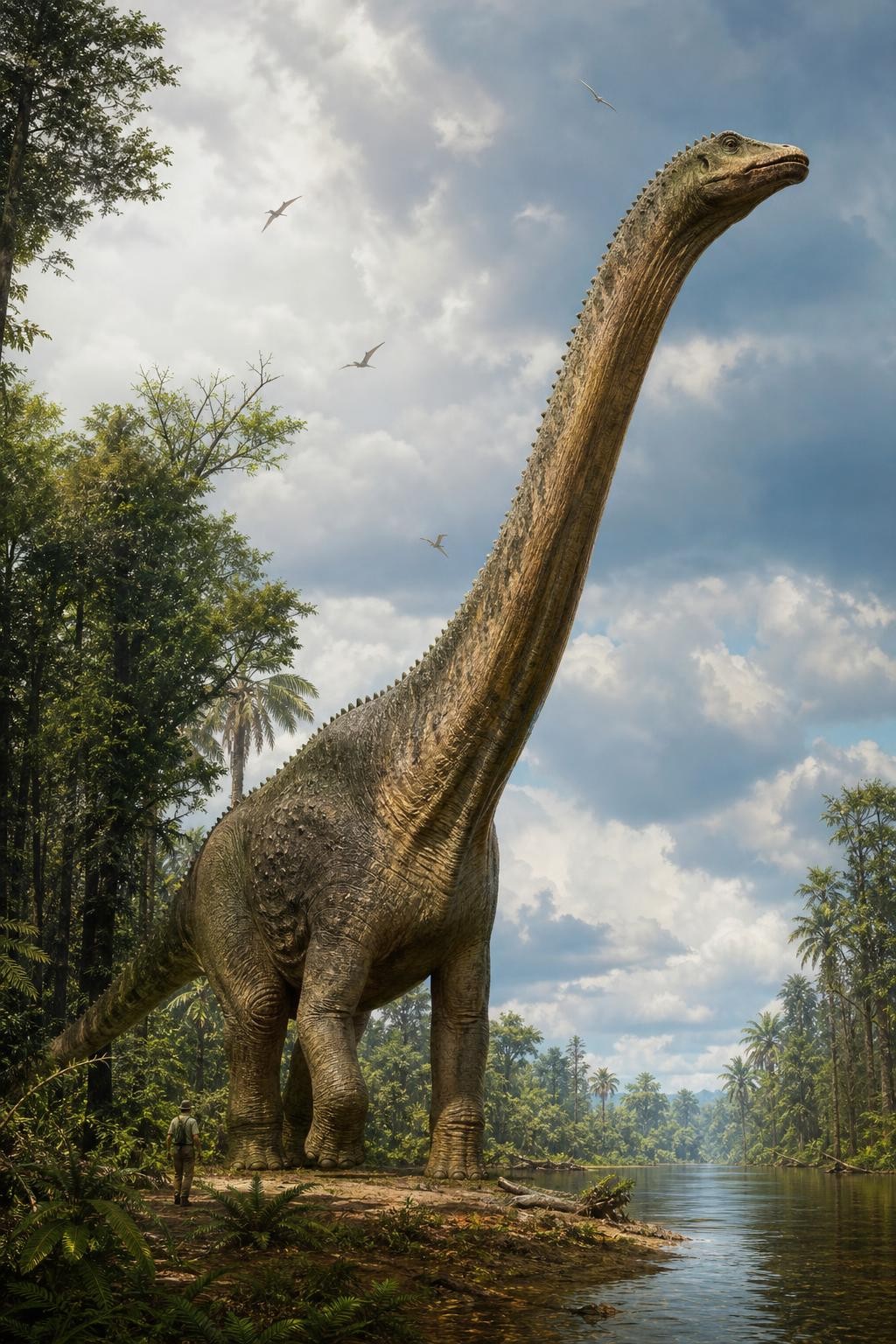
A construction site in northeastern Brazil has revealed a giant that spent roughly 120 million years hidden beneath the ground. The newly identified Dasosaurus tocantinensis was a long-necked sauropod measuring about 20 meters—approximately 65 feet—from head to tail. Its discovery also points across the ancient world to the animal’s closest known relative, which lived in what is now Spain.
A Dinosaur Beneath a Modern Construction Project
The fossils were found in Davinópolis, in Maranhão state, while a road-rail terminal was under construction. Archaeologists monitoring the project as part of environmental licensing discovered bones about 8 meters, or 26 feet, below the surface.
At first, the remains were thought to belong to large prehistoric mammals from the Ice Age. Their depth, however, suggested a much older story. In 2021, Elver Luiz Mayer of the Federal University of the São Francisco Valley, or UNIVASF, became involved and recognized that the bones came from the transition between the Lower and Upper Cretaceous, around 120 million years ago.
Mayer then assembled a multidisciplinary research team to study the specimen and determine what kind of animal had been buried at the site.
A New Giant from Maranhão
The animal was named Dasosaurus tocantinensis. It was a titanosauriform, a group of long-necked plant-eating dinosaurs that includes some of the largest land animals known from the fossil record.
The specimen is relatively complete compared with many dinosaur discoveries. Researchers recovered tail vertebrae, ribs, bones from the feet, and bones from both the arms and legs. One femur measured 1.5 meters, or nearly 5 feet, long. Additional bones from the same individual may still be buried at the construction site.
At about 20 meters long, Dasosaurus is the largest dinosaur currently known from Maranhão. The state’s previously known dinosaur, Amazonsaurus maranhensis, measured about 10 meters, making the new animal roughly twice as long.
The name reflects the region. “Daso” refers to forest, recalling Maranhão’s wooded landscape and early Portuguese descriptions of a dense tangle of vegetation. “Tocantinensis” refers to the Tocantins River, near whose eastern bank the fossils were found.
Its Closest Relative Lived in Spain
The discovery is important not only because of the dinosaur’s size. Researchers say its closest known relative lived in what is now Spain, raising questions about how these animals spread across ancient landscapes.
The team proposes that the ancestors of Dasosaurus reached South America through North Africa sometime between 140 million and 120 million years ago. During that period, the landmasses were still connected through Gondwana and other land connections involving Europe, Africa, and South America.
That proposed route helps explain why a dinosaur discovered in Brazil could have such a close evolutionary connection to one from Spain. The relationship is based on the fossil’s anatomical characteristics and the broader history of dinosaur distribution, although ancient geographic connections were complex and continue to be studied.
Bones That Preserve a Growth Story
Researchers also examined the microscopic structure of the dinosaur’s bones. Bone histology, conducted by Tito Aureliano and Aline Ghilardi of the Federal University of Rio Grande do Norte, showed a combination of traits.
Some aspects of the growth pattern resembled older sauropods, while others were associated with titanosaur features. The findings suggest that certain bone-growth patterns may have appeared earlier in dinosaur evolution than previously thought.
That matters because growth patterns can help scientists understand how sauropods achieved enormous body sizes. The new evidence may contribute to explanations of how these animals grew and evolved into giants, though one fossil cannot resolve every question about sauropod biology.
Why Construction Sites Matter to Paleontology
The discovery also illustrates an unusual reality of fossil hunting in tropical Brazil. Dense vegetation can hide exposed rock, making natural discoveries difficult. According to Max Langer of the University of São Paulo’s Ribeirão Preto campus, human activity such as highway building, quarrying, and major construction projects can expose layers that would otherwise remain inaccessible.
That opportunity comes with a challenge. Specialized monitoring is needed during construction, but it does not always take place. In this case, archaeological monitoring led to the recognition and recovery of scientifically valuable fossils.
The specimen is being kept in São Luís at the State Center for Natural History and Archaeology Research. Researchers are negotiating with the construction company to return to the site and excavate more of the area. If additional bones are present, they could provide further information about the animal’s skeleton, age, and life.
Takeaway
The new dinosaur Brazil discovery, Dasosaurus tocantinensis, adds a 65-foot titanosauriform to the fossil record of South America and expands the known dinosaur story between Brazil and Spain. Found deep beneath a modern road-rail terminal project, the fossils preserve clues about ancient migration, sauropod growth, and the importance of careful fossil monitoring wherever construction exposes the distant past.
Sources
– ScienceDaily: New titanosauriform with European affinities in the Early Cretaceous of Brazil
– EurekAlert: New titanosauriform with European affinities in the Early Cretaceous of Brazil


