Catching a star in the first days of its death is hard enough nearby. The James Webb Space Telescope may have done it in the early universe. A possible early-universe supernova, named AT 2026abck, appears to have been seen just four to ten days after it exploded, Phys.org reported on 13 October.
How it was found
The event turned up in NEXUS, a Webb program that revisits the same patch of sky every two months. On 28 May 2026 the spot was empty. About 71 days later, a new point of light had appeared, more than 3.6 times brighter in one of Webb’s filters.
It sits in a star-forming galaxy at a redshift of about 5, which means we are seeing light from when the universe was young. Unlike many distant finds, it was spotted without help from gravitational lensing, the magnifying effect of a foreground galaxy or cluster.
Why it looks so young
Modelling suggests a temperature of about 17,000 Kelvin and a very high brightness. Among 34 well-observed nearby Type II supernovae, none stayed that hot after a few days or reached that brightness so early. That is why the team, led by Ming-Yang Zhuang of the University of Illinois Urbana-Champaign, thinks they caught it within days of the blast.
Two possibilities
- A Type II supernova, the collapse of a massive star, which should fade quickly in ultraviolet light.
- A superluminous supernova caught on the rise, which would keep brightening.
Follow-up observations with Webb are designed to tell the two apart. The paper was posted to the arXiv preprint server and has not yet been peer reviewed.
More in our Science section.
Source: Phys.org, 13 October 2026.
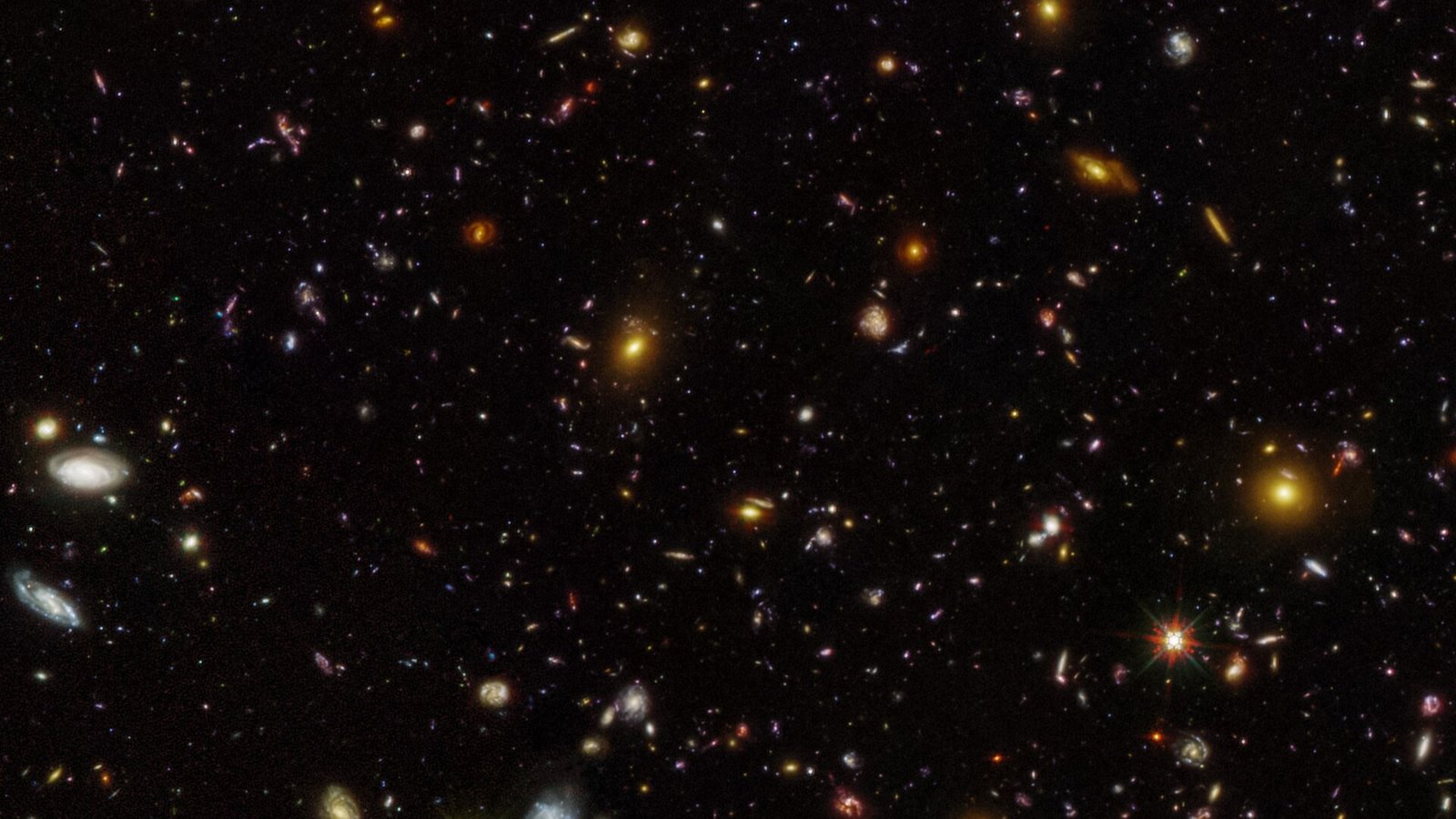
Featured image: Supermassive Black Holes in Hubble Ultra Deep Field (2024-032) by Science NASA, ESA, Matthew Hayes (Stockholm University) Acknowledgment Steven V., Public domain, via Wikimedia Commons.


