Quick answer: A 2022 study led by Ian Cousins of Stockholm University found that rainwater around the world contains “forever chemicals” (PFAS) at levels that often exceed the strictest drinking-water guidelines ever issued. For PFOA, one of the best-studied of these chemicals, even the cleanest rain in the data, from the remote Tibetan Plateau, had a median level about 14 times above the US Environmental Protection Agency’s 2022 lifetime health advisory. That is why the authors said rainwater “everywhere would be judged unsafe to drink” by that benchmark. It does not mean a rain shower will make you sick, and the comparison is with a guideline that is far stricter than the enforceable US limit set later.
The finding keeps resurfacing on social media as “rain is no longer safe to drink anywhere on Earth.” That headline is close to what the scientists said, but the details matter. Here is what the study measured, what the numbers mean and what you can do about PFAS in your own water.
What did the study find?
The paper, “Outside the Safe Operating Space of a New Planetary Boundary for Per- and Polyfluoroalkyl Substances (PFAS)”, was published in August 2022 in the peer-reviewed journal Environmental Science & Technology by researchers from Stockholm University and ETH Zurich. It is a perspective article: rather than collecting new samples, the team reviewed rainwater, soil and surface-water measurements published by other groups and compared them with recent health guidelines.
The analysis focused on four of the best-studied PFAS: PFOA, PFOS, PFHxS and PFNA. For rain, the authors only used studies whose samples were collected and analyzed from 2010 onward, after the main manufacturer, 3M, phased out these long-chain chemicals in 2000 to 2002 and after lab methods improved.
According to the open-access full text, their main conclusions were:
- PFOA in rain “greatly” exceeded the US EPA’s 2022 lifetime drinking-water health advisory of 0.004 nanograms per litre, even in remote areas. The lowest value came from the Tibetan Plateau, with a median of 0.055 ng/L, roughly 14 times the advisory.
- PFOS in rain often exceeded its EPA advisory of 0.02 ng/L, with the exception of two studies from remote regions, in Tibet and Antarctica.
- The sum of the four PFAS in rain often exceeded Denmark’s drinking-water limit of 2 ng/L in cities and the countryside, and in some remote regions too.
- Soils worldwide are contaminated through atmospheric deposition, often above guideline values proposed in the Netherlands.
From this, the authors argued that PFAS pollution has crossed a “planetary boundary,” a scientific framework for limits beyond which human activity risks destabilizing Earth’s systems.
Why “unsafe to drink” comes with a caveat
The phrase comes from the Stockholm University press release, in which Cousins said: “Based on the latest U.S. guidelines for PFOA in drinking water, rainwater everywhere would be judged unsafe to drink.” The key words are “based on the latest U.S. guidelines.” The study is a comparison with health-based benchmarks, not a measurement of people getting ill from rain.
Cousins made that distinction himself in an interview with BBC News: “I’m not saying that we’re all going to die of these effects. But we’re in a place now where you can’t live anywhere on the planet, and be sure that the environment is safe.”
Why the safety limits fell so far
A big part of the story is how quickly regulators have tightened their PFAS guidance. The paper notes that a PFOA drinking-water guideline once used in West Virginia was 150,000 ng/L, about 37.5 million times higher than the EPA’s 2022 advisory. The EPA’s own previous advisory was 70 ng/L for PFOA and PFOS combined.
The 2022 advisories were based on human studies, and the most sensitive effect EPA used to set them was a weaker antibody response to vaccines in children. Europe moved in the same direction: in 2020 the European Food Safety Authority set a tolerable weekly intake for the four PFAS based on effects on the immune system, which Denmark then used for its 2 ng/L drinking-water limit.
In other words, the rain did not suddenly get much dirtier. Scientists learned that these chemicals can matter at much lower doses than once thought, and the guidelines caught up.
How the rules have changed since 2022
The EPA advisories the study used were non-regulatory. In April 2024, the agency finalized the first enforceable national drinking-water limits for PFAS, setting maximum contaminant levels of 4.0 ng/L (4 parts per trillion) for PFOA and PFOS. At the same time, EPA set the health-based goals for both chemicals at zero, meaning it identifies no level of exposure without risk; the enforceable limits were set as close to that goal as the agency judged feasible.
That 4 ng/L limit is 1,000 times higher than the 2022 PFOA advisory, so typical remote rain like the Tibetan samples would fall below it. The study’s headline therefore rests on the strictest benchmark available at the time, which is a fair basis for a scientific warning but not the legal standard water utilities must meet. In May 2026, EPA proposed keeping both limits while giving water systems the option of two more years, until 2031, to comply.
Why PFAS keep falling with the rain
PFAS are a family of thousands of human-made chemicals used since the 1940s in non-stick cookware, food packaging, waterproof clothing, stain-resistant fabrics and firefighting foam, according to the EPA. They are called “forever chemicals” because they barely break down in the environment.
The Stockholm team says levels of some harmful PFAS in the atmosphere have not declined notably, even two decades after 3M’s phase-out. Part of the reason is that nature keeps recycling them: PFAS in the oceans are thrown back into the air in sea spray, then carried long distances and washed out again by rain and snow. That is how they reach places with almost no people.
What you can do about PFAS in your water
- Check your local results first. The EPA advises contacting your water provider to find out which PFAS, if any, are in your supply. Many utilities already publish test results.
- If you use a filter, make sure it is certified for PFAS. According to the EPA, not all filters address PFAS, and current certifications focus on PFOA and PFOS. Options range from pitcher and faucet filters to under-sink reverse osmosis systems, and they need regular maintenance.
- Don’t rely on boiling. Wisconsin’s health department warns that boiling unfiltered water will not reduce PFAS and may concentrate them.
- If you drink collected rainwater, remember that PFAS are only one consideration. Treat and test it as you would any untreated water source.
For more environmental science, read our report on how this year’s “super” El Niño could hit ecosystems worldwide, our look at a graphene filter designed to widen access to clean water and our explainer on how satellites are changing climate science. More in our Science section.
Frequently asked questions
Is rainwater safe to drink?
By the strictest health benchmark, the US EPA’s 2022 lifetime advisory for PFOA, rainwater almost everywhere exceeds the safe level, according to a 2022 Stockholm University study. Rain can also carry microbes and other pollutants, so it should be treated and tested before drinking.
What are PFAS?
PFAS (per- and polyfluoroalkyl substances) are thousands of human-made chemicals used in non-stick, waterproof and stain-resistant products and firefighting foam. They are called forever chemicals because they barely break down in the environment.
Did the study find PFAS in Antarctic rain?
PFAS have been detected in precipitation even in remote regions, including Antarctica and the Tibetan Plateau. In the study’s data, PFOS levels in those two remote regions were below the EPA’s PFOS advisory, while PFOA exceeded its advisory even on the Tibetan Plateau.
Does boiling water remove PFAS?
No. Health authorities such as Wisconsin’s Department of Health Services say boiling unfiltered water will not reduce PFAS and may concentrate them. A filter certified to reduce PFOA and PFOS is the recommended option.
What is the legal limit for PFAS in US drinking water?
Since April 2024, the EPA’s enforceable limits are 4.0 parts per trillion each for PFOA and PFOS. A 2026 EPA proposal would keep those limits but let water systems request until 2031 to comply.
Sources: Cousins et al., Environmental Science & Technology (2022); Stockholm University; BBC News; US EPA, PFAS drinking water regulation; US EPA, proposed compliance extension; US EPA, home filters; Wisconsin Department of Health Services.
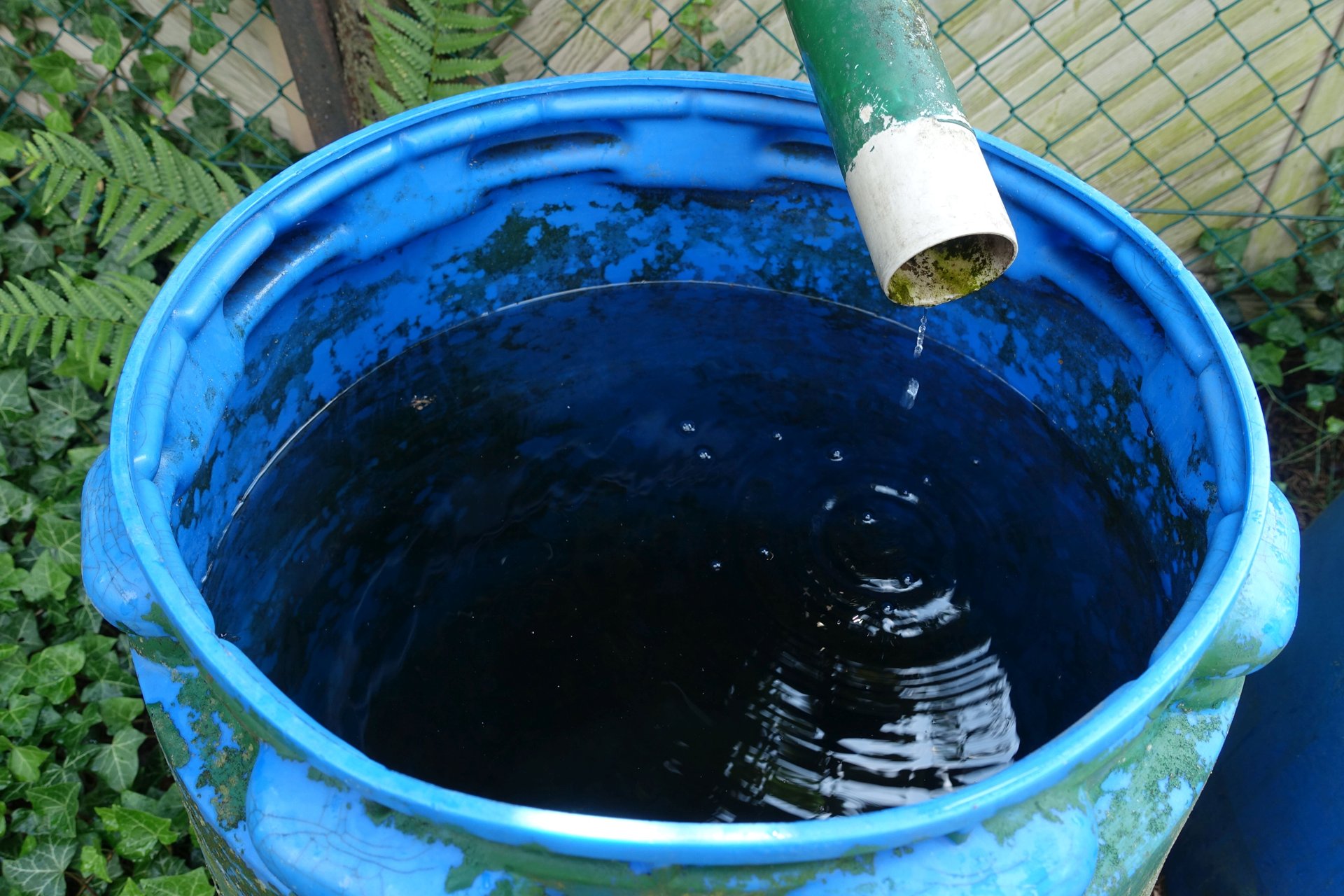
Featured image: rainwater from a roof drain collected in a plastic drum, by Kmtextor, CC BY-SA 4.0, via Wikimedia Commons.


